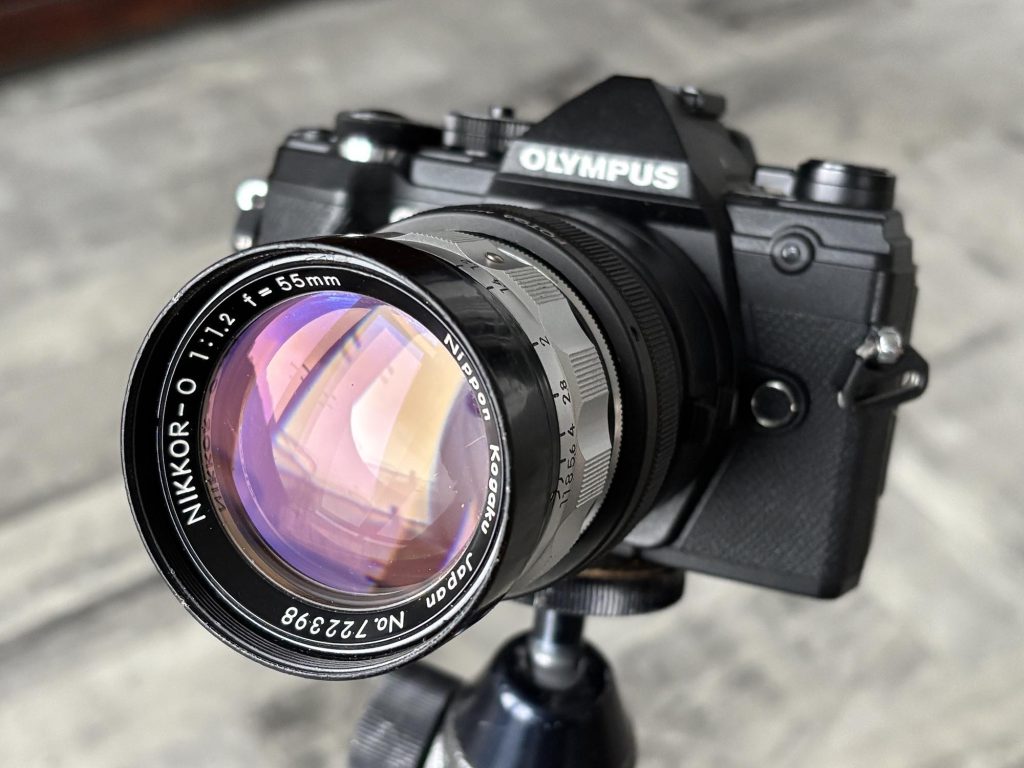
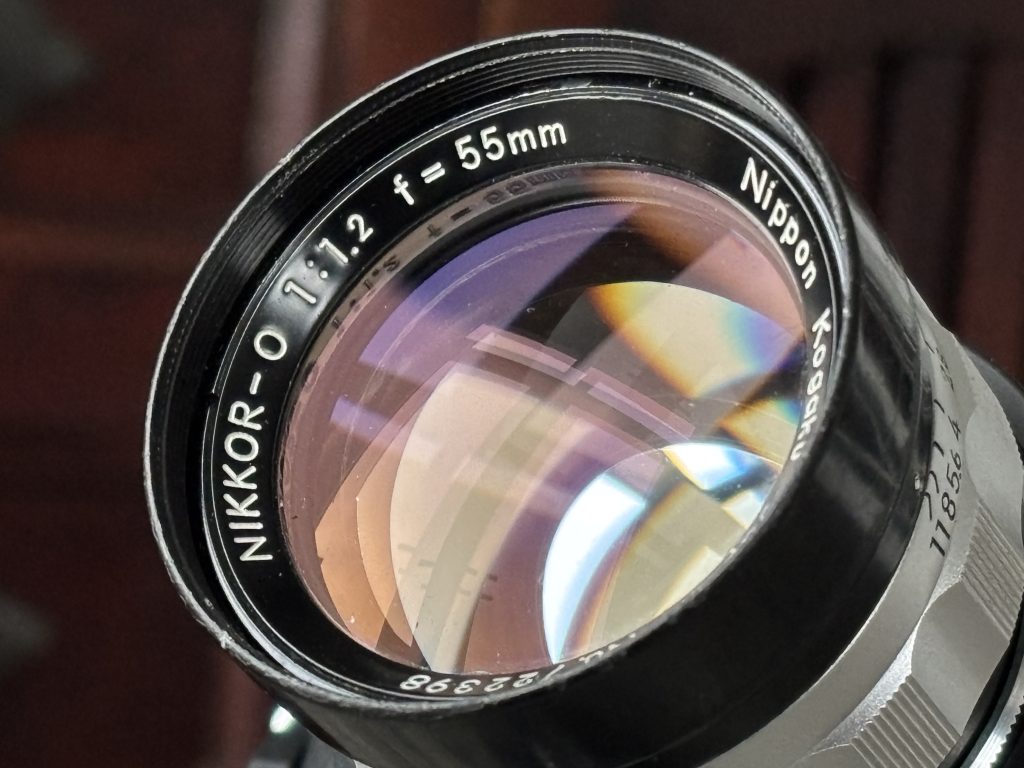
The Nikkor-O 55mm f/1.2 is one of Nikon’s most character-rich standard lenses. Produced in the late 1960s by Nippon Kagaku, it represents a transitional period when ultra-fast lenses were engineering statements as much as photographic tools. Today, it’s rare, collectible, and beloved for its distinctive rendering rather than clinical perfection.
This guide covers its history, optical character, handling, buying considerations, and how to get the best from it in modern use.
Historical Context
In the 1960s, pushing aperture boundaries was a prestige race among camera manufacturers. Nikon introduced the 55mm f/1.2 before the more common 50mm f/1.2 designs became standard. The “O” designation refers to its 7-element optical formula (“O” indicating seven elements in Nikon’s naming convention of the era).
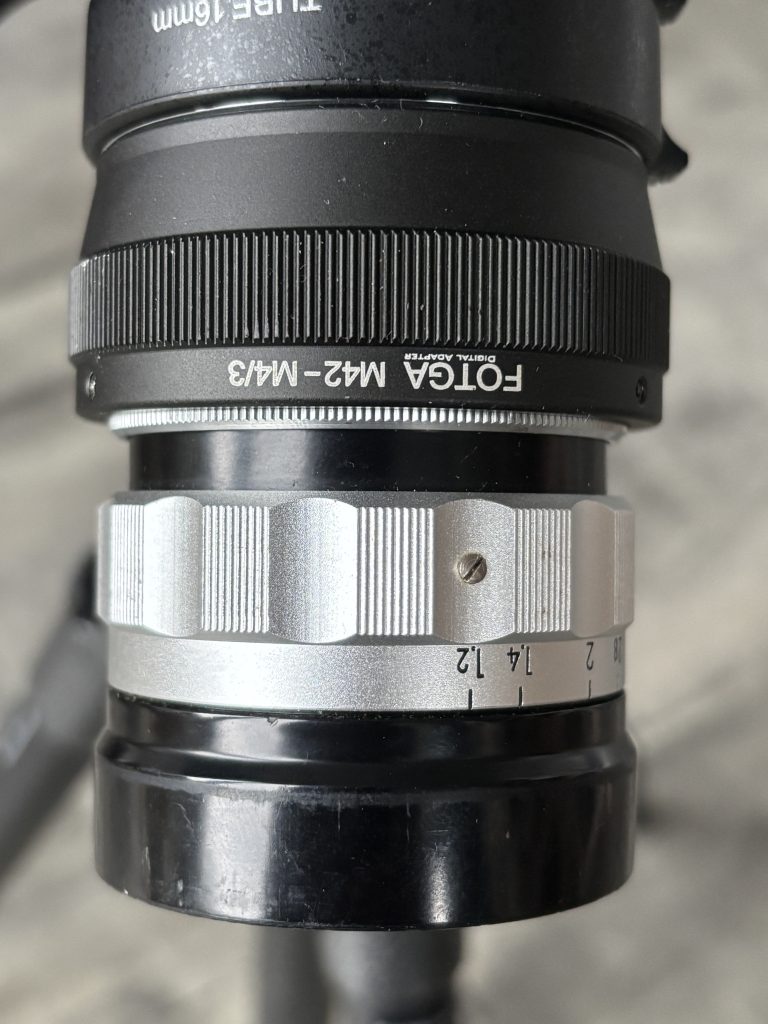
The lens is not designed to be mounted on a standard Nikon AI Mount SLR, and has a Leica M39 thread mount. You can buy an M39-to-Nikon F-mount adapter to mount the lens on a Nikon SLR.
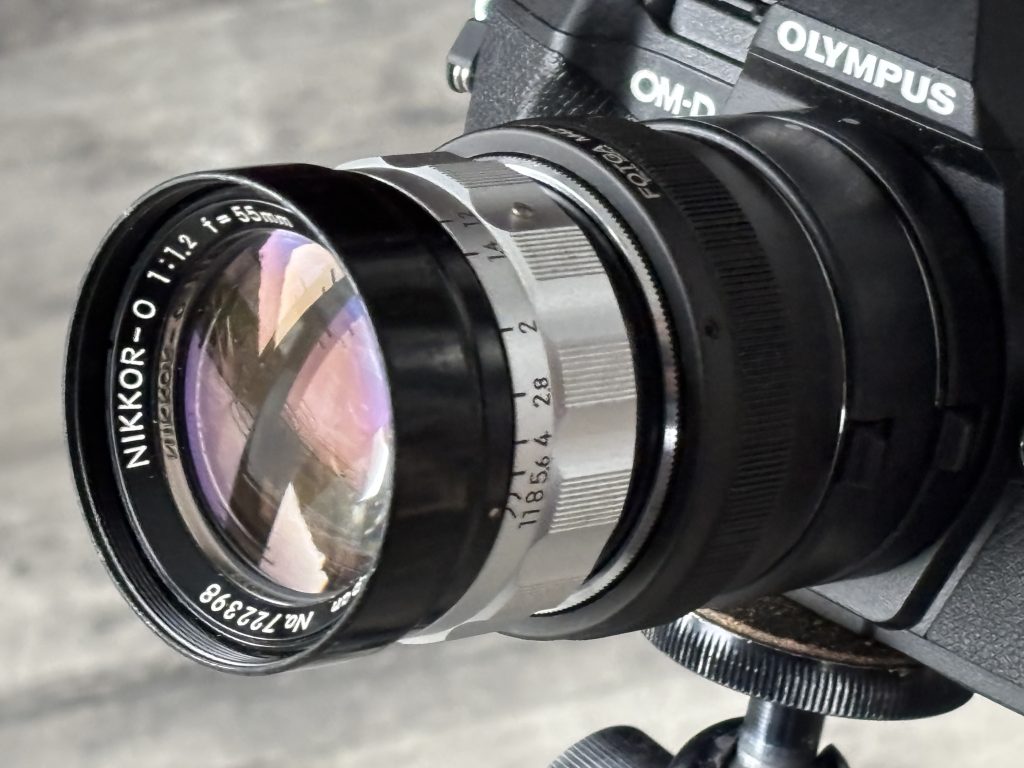
The one I have for sale doesn’t have a thread so I’ve converted it to Micro 4/3rds for use on my Olympus E-M5III, using an adaptor previously used to convert M42 to M 4/3.
Production numbers were relatively low compared to later 50mm f/1.2 lenses, contributing to its rarity.
Optical Design & Rendering Character
Core Specs
• Focal Length: 55mm
• Maximum Aperture: f/1.2
• Minimum Aperture: f/11
• Aperture blades: 12
• Optical Construction: 7 elements
• Focus: Manual
• Mount: Leica M39 Screw
Wide Open (f/1.2)
This is where the magic—and quirks—live:
• Dreamy glow from spherical aberration
• Lower contrast
• Gentle highlight bloom
• Swirly or nervous bokeh depending on distance
It is not clinically sharp at f/1.2. Instead, it produces an almost cinematic softness that flatters portraits and night scenes.

Stopped Down (f/2 – f/2.8)
• Contrast increases dramatically
• Sharpness improves significantly
• Glow reduces but character remains
At f/2.8 and beyond, it behaves like a strong vintage standard lens with rich tonal rendering.
What Makes It Special
1. Transitional Rendering
Unlike modern ultra-fast lenses that aim for perfection wide open, this lens embraces imperfection. It’s expressive rather than analytical.

2. 55mm Focal Length
The slightly longer-than-50mm perspective:
• Adds subtle compression
• Feels natural for portraits
• Gives a distinct look compared to standard 50mm lenses
3. Build Quality
Heavy, solid brass construction
Long, smooth focus throw
Deep mechanical feel typical of late-60s Nikon craftsmanship
Compatibility Guide
Because most copies are Pre-AI, mounting them on modern Nikon DSLRs without modification can damage the camera’s aperture indexing tab.
Safe Use Options:
• Mirrorless cameras with adapters (excellent pairing)
• Pre-AI compatible Nikon bodies (e.g., older F-series)
• AI-converted copies
Before mounting on a modern DSLR:
✔ Confirm AI conversion
✔ Or use an adapter on mirrorless
Best Use Cases
✦ Portraiture
The glow at f/1.2 softens skin beautifully.
✦ Night Photography
Point light sources bloom dramatically for atmospheric city scenes.
✦ Artistic Work
It excels in:
• Moody black-and-white
• Backlit subjects
• Environmental portraits
Buying Guide
Because this lens is rare, condition matters greatly.
What to Check:
1. Fungus & Haze
Fast vintage lenses are prone to internal haze due to aging coatings.
2. Oil on Aperture Blades
Check for smooth, snappy aperture action.
3. Serial Numbers
Early and late batches show minor cosmetic differences, but optical formula remains consistent.
Price Range
Prices vary depending on:
• Condition
• AI conversion
• Cosmetic wear
• Market demand
Expect it to command a premium over standard vintage 50mm f/1.2 lenses due to rarity.
Shooting Tips
1. Embrace the Glow
Don’t fight the softness wide open. Use it intentionally.
2. Control Flare
It can flare dramatically. Use:
• A deep lens hood
• Careful light positioning
3. Focus Carefully
At f/1.2, depth of field is razor thin. Use:
• Focus magnification (mirrorless)
• Split-prism screens (film bodies)
4. Black & White Magic
The tonal transitions at f/1.2 are particularly beautiful in monochrome conversions.

How It Compares to Later Nikon f/1.2 Lenses
Compared to later 50mm f/1.2 designs:
• More glow
• Less correction
• More vintage signature
• Slightly more unique focal perspective
It feels less engineered for precision and more for character.
Collector Value
The Nikkor-O 55mm f/1.2 is desirable because:
• It represents Nikon’s early ultra-fast design philosophy
• It has limited production numbers
• It offers rendering not easily replicated by modern lenses
Clean, original-condition copies are increasingly hard to find.
Who Should Buy It?
Buy this lens if you:
✔ Love vintage rendering
✔ Shoot portraits or atmospheric scenes
✔ Use mirrorless cameras
✔ Appreciate mechanical craftsmanship
✔ Want something rarer than a standard 50mm f/1.2
Avoid it if you:
✘ Need edge-to-edge sharpness at f/1.2
✘ Prefer modern contrast and coatings
✘ Don’t want to deal with manual focus
Final Thoughts
The Nikkor-O 55mm f/1.2 is not about technical perfection. It’s about atmosphere, mood, and character. It’s a lens from an era when speed was ambitious and flaws were part of the signature.
In a world of optically flawless modern glass, this lens stands out precisely because it isn’t flawless — and that’s why it remains one of Nikon’s most intriguing rare classics.